

© Copyright 2022

In the case of changes to the family structure or the company’s financial situation, entrepreneurs may find themselves faced with the problem that asset-related decisions previously made for their private affairs no longer fit the current circumstances.
There are various ways to address this,
particularly through wills, company law, and matrimonial property law. This allows for a response to changing circumstances at both the company and family levels, and enables more appropriate and holistic arrangements to be found. Just as a will can, in principle, be amended at any time and the articles of association and company form can, in principle, be amended at any time, the matrimonial property regime can also be amended retrospectively during an existing marriage, even without death or divorce.
Thus, even retrospectively,
the statutory matrimonial property regime may be revoked by a notarised marriage contract - which must be in writing. The accrued gains calculated up to that point usually result in a settlement payment to one spouse, which does not constitute a gift in this respect. This can be advantageous in view of the size of the existing assets and the unencumbered capital available for the settlement, and places the least strain on the liquidity of a business forming part of the assets. However, a further consequence is that the currently available assets are encumbered by the payment of the settlement and are reduced accordingly. A side effect of this may be that, for example, a person entitled to a compulsory share may be able to claim a smaller compulsory share due to the corresponding reduction in the basis of assessment.
The Kreuzer Tip
Wills, articles of association and marriage contracts offer various means of structuring arrangements to enable a retrospective response to changing life circumstances and economic developments. Legal advice is therefore strongly recommended in order to examine, at all levels, how to coordinate adjustments to changing circumstances (in particular with regard to existing risks of invalidity concerning potential beneficiaries of a compulsory share).
Entrepreneurs are often actively supported in their businesses by family members, but this can lead to problems later on if the corporate or labour law framework is not appropriately designed.
In particular, the assumption of management functions
by family members, such as sons or daughters who are supposed to take over the business anyway and who already assume a leadership role during the lifetime of e.g. their parents carries high risks. In such constellations, it is often the case that the children are functionally authorised signatories or even managing directors without actually holding company shares and without an employment contract. Those involved often believe that this is a self-employed activity.
In situations where
children do not hold any shares in the company despite holding a management position (i.e. without their own ‘legal authority’), they are treated as employees in legal terms, particularly with regard to social security and labour law. As a result, they have various rights, such as holiday entitlement, just like any other employee, and their work is subject to social security law. In addition to possible claims for damages by the children themselves, this may result in claims for back payments from social security institutions or the tax office, which, depending on the circumstances, may also affect the children themselves later as heirs. Under certain circumstances, criminal and tax law consequences may also be considered.
The Kreuzer tip
Employing family members in management positions in your own company without sufficient participation in company law (i.e. without your own ‘legal authority’) can have serious consequences if there is no proper employment relationship. Legal advice is therefore urgently recommended in order to check the protection under labour law and company law.
When it comes to business succession, it is often overlooked that entitlements to compulsory portions can have significant financial consequences. If a business is transferred to only one of the potential heirs as the successor, the other heirs are generally entitled to legal portions in cash. These claims arise immediately upon the opening of the succession and must, in principle, be settled at short notice.
Entitlements to a compulsory portion always affect liquidity,
as they cannot be settled unilaterally through the transfer of company shares, but must be paid in cash. This can lead to considerable financing difficulties, particularly where assets are tied up in the business.
Company assets often have to be realised
if there are insufficient liquid funds available. In the worst-case scenario, this leads to the sale of company shares or business assets.
Even arrangements made during one’s lifetime are not a cure-all,
as gifts may, under certain circumstances, be taken into account again through claims for a supplementary compulsory portion. Without forward-looking planning, significant risks remain.
The Kreuzer Tip
Entitlements to a compulsory portion should be incorporated into succession planning at an early stage. Liquidity risks can be significantly reduced through waivers of statutory shares, coordinated asset transfers and clear structures. Without appropriate provision, the statutory share may jeopardise the continued existence of the business. Legal advice is therefore strongly recommended.
When it comes to business succession, it is often overlooked that entitlements to compulsory portions can have significant financial consequences. If a business is transferred to only one of the potential heirs as the successor, the other heirs are generally entitled to legal portions in cash. These claims arise immediately upon the opening of the succession and must, in principle, be settled at short notice.
Entitlements to a compulsory portion always affect liquidity,
as they cannot be settled unilaterally through the transfer of company shares, but must be paid in cash. This can lead to considerable financing difficulties, particularly where assets are tied up in the business.
Company assets often have to be realised
if there are insufficient liquid funds available. In the worst-case scenario, this leads to the sale of company shares or business assets.
Even arrangements made during one’s lifetime are not a cure-all,
as gifts may, under certain circumstances, be taken into account again through claims for a supplementary compulsory portion. Without forward-looking planning, significant risks remain.
The Kreuzer Tip
Entitlements to a compulsory portion should be incorporated into succession planning at an early stage. Liquidity risks can be significantly reduced through waivers of statutory shares, coordinated asset transfers and clear structures. Without appropriate provision, the statutory share may jeopardise the continued existence of the business. Legal advice is therefore strongly recommended.
If an employee consistently fails to meet performance expectations and does not respond to feedback or support measures, the employer may consider dismissing them on the grounds of poor performance. The decisive factor here is the reason for the underperformance – because, depending on the cause, employment law classifies this as either dismissal on personal grounds or dismissal on behavioural grounds, each of which involves different requirements and hurdles. If this distinction is made incorrectly, a subsequent judicial review may fail and a claim for wages due to default of acceptance may arise.
A dismissal may be for behavioural reasons
if the employee culpably fails to make full use of their capacity. This means: they could perform better but do not – for example, due to a lack of motivation, a lack of discipline or a deliberate refusal to work. In this context, employment law requires controllable, culpable behaviour. As a rule, a written warning is mandatory prior to dismissal in order to draw the employee’s attention to the breach of duty, give them the opportunity to improve, and make clear the consequences of continued underperformance.
A dismissal is, however, deemed to be for personal reasons
if the employee is objectively unable to perform the duties required of them. Reasons may include health restrictions, age-related declines in performance, or a lack of personal suitability. Fault on the part of the employee is not required in such cases. However, it is a prerequisite that the employer can demonstrate that the employee’s performance has been significantly below the average of comparable employees over an extended period. This requires verifiable figures, documentation and objective comparative data. Furthermore, the employer must demonstrate that milder measures such as warnings, training or support meetings have been unsuccessful and that no improvement in performance is to be expected in the future.
The Kreuzer Tip
Employers should document poor performance at an early stage, provide regular feedback and offer measures for improvement in order to establish a sound basis for subsequent steps. Employees, for their part, should take warnings seriously, clarify the causes and actively seek support. They can successfully defend themselves in unfair dismissal proceedings if they demonstrate that they were willing to work and fundamentally possess the ability to perform the required duties. In conflict situations, legal advice is therefore advisable for both sides – because in cases of ‘low performance’, it is not impressions that matter, but what can be legally proven.
Temporary agency work offers companies flexibility, but is subject to strict regulations. Anyone supplying workers requires official authorisation. Breaches of the Temporary Agency Work Act (AÜG) can result in fines, withdrawal of authorisation and – attention, hirers! – the establishment of an employment relationship with the hirer themselves.
The principle of equal pay applies,
under which the temporary employment agency must grant the temporary worker the essential terms and conditions of employment applicable to comparable employees at the user company, including remuneration, during the assignment. Deviations are permitted only through collective agreements (the user company must be a member of an employers’ association or the terms must be included in the employment contract) during the first nine months, but remuneration must not fall below the minimum rates.
The maximum assignment period must be strictly observed,
as temporary workers may only be assigned to the same hirer for a maximum of 18 months. Previous assignments are included in this calculation if the breaks between them were no longer than three months. If this limit is exceeded, the employment contract with the lender becomes void. An employment relationship is then established solely with the hirer. Temporary workers are entitled to the same rights as permanent staff. The user and the lender are jointly and severally liable for remuneration claims.
The Kreuzer Tip
Companies must comply with the licensing requirement, the equal pay principle and the maximum assignment period. Breaches are very risky, e.g. an employment relationship with the user! Documentation and monitoring of working hours are essential. Legal advice is strongly recommended.
When companies hire new employees, they want to be sure that they can test the skills of the new employees, but that they can also part ways with these employees if they do not fulfil expectations.
The agreement of a probationary period
is a good way of fulfilling this aim. This period can be up to six months by law, although it should be noted that collective agreements may deviate from the norm and special rules apply to certain employees, such as pregnant women. The probationary period and its exhaustion are generally a matter for negotiation between the parties to the employment contract. The notice period during this period is two weeks, i.e. it is shortened, even if the works council – if it exists - must be consulted. Furthermore, no reason for dismissal has to be given.
The Dismissal Protection Act
is generally applicable in companies with more than ten employees (possibly as few as five in the case of long-established employees). In this case, special requirements must be observed in the event of a dismissal, which means a considerable amount of work. In companies where the Dismissal Protection Act applies, for example, contractual dismissal for operational reasons must be socially justified. This means that, among other things, a specific reason for dismissal (e.g. loss of working place) must be presented in detail and a correct social selection must have been made. However, a further requirement for the application of the Dismissal Protection Act is that the employment relationship must have existed for at least six months. This means, however, that a dismissal is possible within this six-month period without observing the above-mentioned special requirements.
The Kreuzer tip
The agreement of a probationary period is a good addition to new employment contracts from the point of view of the shortenable notice period. Legal advice is therefore urgently required in order to examine the structuring options for a probationary period agreement (including provisions under collective bargaining law) in companies with more than 10 (or 5, see above) employees.
A large number of companies are already up for sale today, but the number will only increase in the coming years due to the retirement of the baby boomer generation. Even if there are differences in the details (especially when comparing partnerships and corporations), some more general points should always be taken into account.
The confidentiality obligation
also known as a non-disclosure agreement or confidential disclosure agreement, should always be included at the beginning of negotiations and the exchange of company information, but at the latest before the start of due diligence. After all, the process includes the exchange of internal company information and other data which is not intended for the public, so that the buyer can examine the technical, financial and legal details of the company from the point of view of the company's intrinsic value. From a legal perspective, e.g., all existing contracts have to be analysed for risks relevant to the purchase price.
At the end of this review, the purchase agreement is signed,
in the form of an asset deal (for assets and sole proprietorships) and/or a share deal (for shares in corporations). There are numerous points to consider here, particularly with regard to the contracts to be taken over, guarantees, and the liability for liabilities stemming from the past. In the case of partial share sales, it is also necessary to check whether managing director contracts need to be amended, as shareholder-managing directors can become normal employees in the case of partial share sales. There are also numerous options for structuring the exit of the previous shareholder, especially if company shares are initially only to be partially transferred and the exit is only to take place after a certain period. Constellations in which investors are to be taken on as shareholders with a simultaneous capital increase are comparably complex. This may even entail a change in the legal form, or at least provisions on holding and purchase options.
The Kreuzer Tip
A company acquisition presents the parties involved with numerous legal issues and problems, but also offers many structuring options in the various phases from the initial discussions to the sale. Legal advice is therefore urgently required.
Als professionelles und modernes Netzwerk internationaler Anwaltskanzleien war ij INTERNATIONAL JURISTS schon immer bestrebt, neue Wege der Kommunikation und Zusammenarbeit zu erkunden. Aus diesem Grund waren unsere Mitglieder Frederico Vasoli und Domenic Pini nun zu Gast bei Mac-Arthur Pierre-Louis und dem @lmipodcast.
Sie sprachen über das Netzwerk, seine Besonderheiten und seine Vorteile, insbesondere im Kontext einer zunehmend vernetzten Welt, aber außerdem auch über Zukunftspläne wie die Hoffnung auf eine weitere Expansion.
Lesen Sie mehr auf dem Blog, sehen Sie sich das ganze Interview auf YouTube an oder finden Sie es zum Anhören auf Spotify.
Büro Nürnberg
0911 2022 0
nuernberg@kreuzer.de
Büro Dresden
0351 31550 0
dresden@kreuzer.de

Mac-Arthur Pierre-Louis, Frederico Vasoli und Domenic Pini (v. l. n. r.)
It is becoming increasingly common for people to have their centre of life in another EU country, even though their assets, property, company shares or business premises are located in Germany.
If the assets to be inherited
are located in different countries or if the testator does not have their centre of life in the country of their nationality, this can lead to difficulties in the event of death, as different legal systems may conflict. Different inheritance laws may have different rules regarding statutory heirs and inheritance shares, as well as the succession itself. Not all forms of will are permitted in every country. To ensure that those intended to inherit, for example, shares in a company (particularly if not all heirs are to be successors), it is therefore important not only to make an explicit provision but also to ensure that the appropriate law applies to the estate. In some circumstances, different legal systems may be applied concurrently, for example in relation to property and shares in a company.
It is therefore advisable
to draw up a will containing a choice of law clause in situations involving the EU. Such a clause specifies the legal system under which the succession is to be governed. Under the relevant EU regulation, one may opt for the legal system of the country of nationality or the country where the deceased had their centre of vital interests. In this way, it is possible to ensure that the desired succession takes place, even if a will would not be necessary in the case of a purely German succession.
The Kreuzer Tip
Cross-border inheritance can involve significant problems, even if the same inheritance under German law appears less complicated. Legal advice is therefore strongly recommended to ensure that arrangements are made which guarantee the desired succession.
Die Verkehrswacht Nürnberg e.V. und DR KREUZER RECHTSANWÄLTE hatten zum 23. Verkehrssicherheitsforum unter dem Titel "Urbane Mobilität - Pedelec, Lastenrad und Co. im Lichte der Verkehrssicherheit" eingeladen.
Thorsten Goppel, Erster Vorsitzender Verkehrswacht e. V., und Rechtsanwalt Dr. Günther Kreuzer hatten sich sehr gefreut, nach der pandemiebedingten Unterbrechung dieser beliebten Veranstaltungsreihe wieder zahlreiche Gäste in der Kanzlei am Lorenzer Platz begrüßen zu können.
Oliver Leuker, Polizeihauptkommissar, und Rechtsanwalt Tobias Kantz stellten u.a. mit Videobeispielen unterhaltsam aber auch mahnend die Chancen, Herausforderungen und besondere Phänomene dar, die die urbane Mobilität mit sich bringen.
Durch die wachsende Popularität sowie die wachsenden Einsatzmöglichkeiten von Pedelecs, Lasträdern und Co. entsteht auch das wachsende Bedürfnis, sich mit den insoweit bestehenden Gefahren in der Praxis auseinanderzusetzen.
Es wurden die rechtlichen Rahmenbedingungen aufgezeigt und herausgearbeitet, dass insoweit durchaus sicherheitsrelevante Lücken bestehen, die durch den Gesetzgeber möglichst zu schließen sind. Ferner wurde angeregt über die (Un-) Vereinbarkeit der derzeit geltenden Regelungen diskutiert, wie z.B. im Falle der Radwegbenutzungspflicht und den Regelungen hinsichtlich Abmessungen und Gewicht von Lastenrädern (tatsächlich darf ein Lastenfahrrad bis zu 2,55 m breit und 4 m hoch und 12 m lang sein – praktisch schwer vorstellbar auf einem Radweg!).
Im anschließenden Get-together wurde engagiert die Notwendigkeit effizienter und nachhaltiger Fortbewegungsmöglichkeiten in Städten diskutiert und gefordert, dass sich der Gesetzgeber weiter damit auseinandersetzt und geeignete Regelungen zu erarbeitet, um Rechtssicherheit zu schaffen, Unfallgefahren entgegenzuwirken, schwächere Verkehrsteilnehmer zu schützen und schließlich auch, um nachhaltigen Mobilitätsformen den nötigen Verkehrsraum für eine sichere Verkehrsteilnahme zu ermöglichen.
Büro Nürnberg
0911 2022 0
nuernberg@kreuzer.de
Büro Dresden
0351 31550 0
dresden@kreuzer.de

Rechtsanwalt Tobias Kantz DR KREUZER RECHTSANWÄLTE, Rechtsanwalt Dr. Günther Kreuzer DR KREUZER RECHTSANWÄLTE, Thorsten Goppel Erster Vorsitzender Verkehrswacht e. V., Geschäftsführer, Ing.-und SV-Büro Goppel GmbH, Oliver Leuker Polizeihauptkommissar (v. l. n. r.)
Ab sofort suchen wir eine/n Kollegen/in (m/w/d) in Vollzeit/Teilzeit im Zivilrecht, gerne auch Berufsanfänger.
Melden Sie sich bei uns:
oder 0911 2022 0
Wir freuen uns auf Ihre Bewerbung!
Büro Nürnberg
0911 2022 0
nuernberg@kreuzer.de
Büro Dresden
0351 31550 0
dresden@kreuzer.de
Am 13. Juni fand bei DR KREUZER RECHTSANWÄLTE in Nürnberg ein vom COMITES, dem Vertretungsorgan der Auslandsitaliener in der Metropolregion Nürnberg, organisierter Abend als Auftaktveranstaltung einer Reihe zum Thema Gesundheit statt, bei der auch wichtige rechtliche Themen (z.B. Arztrecht, Sozialversicherungsrecht ) diskutiert werden.
Der Titel dabei: "Il cuore italiano che batte a Norimberga" (Das italienische Herz schlägt in Nürnberg).
Für einen gelungenen Abend sorgten unter anderem die Fachärztin für Kardiologie in Fürth Dr. Laura Vitali-Serdoz, die Präsidentin von COMITES Nürnberg Dr. Nicoletta De Rossi und der Beauftragte des italienischen Generalkonsulats München in Nürnberg, Rechtsanwalt Dr. Günther Kreuzer.
Büro Nürnberg
0911 2022 0
nuernberg@kreuzer.de
Büro Dresden
0351 31550 0
dresden@kreuzer.de

Am Donnerstag, 11.07.2024 um 18.30 Uhr findet das 23. Verkehrssicherheitsforum statt.
Dazu laden wir Sie bei DR KREUZER RECHTSANWÄLTE an der Lorenzkirche, 90402 Nürnberg, Lorenzer Platz 3a, Konferenzraum ein.
Rechtsanwalt Dr. Günther Kreuzer moderiert gemeinsam mit dem 1. Vorsitzenden der Verkehrswacht Nürnberg e.V. Thorsten Goppel.
In das Thema “Urbane Mobilität - Pedelec, Lastenrad und Co. im Lichte der Verkehrssicherheit” führt Herr Goppel gemeinsam mit Polizeihauptkommissar Oliver Leuker und Rechtsanwalt Tobias Kantz ein.
Für Anmeldung und Rückfragen können Sie uns telefonisch unter 0911 2022 0, per E-Mail an verkerssicherheitsforum@kreuzer.de oder mit beigefügtem Anmeldebestätigung per Telefax unter 0911 2022-101 erreichen.
Wir bitten um frühzeitige Anmeldung. Das Platzangebot ist begrenzt.
Büro Nürnberg
0911 2022 0
nuernberg@kreuzer.de
Büro Dresden
0351 31550 0
dresden@kreuzer.de
A large number of companies and company shares are already being inherited, but this will increase in the coming years. This can lead to problems for a community of heirs.
Succession to the company
or to a company share can be provided only for certain co-heirs. This procedure is recommended if this successor is already involved in the company and the other co-heirs lack the interest and qualifications for succession. In addition to such a testamentary arrangement, a corresponding provision should be included in the partnership agreement - insofar as this is possible under company law - so that the succession is clearly regulated.
Alternatively, the testator may not make any specific arrangements for the company or the company share. In this case, however, the co-heirs generally succeed jointly and in accordance with their co-heir quota. It is up to the community of heirs to decide whether the company or company share is managed jointly or by an administrator until the community of heirs is divided.
In any case
the company or the company share is a ‘normal’ object of the estate. Two aspects in particular play a special role in the dispute: On the one hand, it is decisive whether or not the value should be taken into account in the event of a specific succession arrangement. Secondly, it must be clarified how the value of the company or the company share is to be calculated. In view of the fact that a comprehensive reform of company law took place at the beginning of the year, which in particular also contained changes with regard to the continued existence of the company, it should be checked whether the testamentary and company law arrangements and contracts are still up to date.
The Kreuzer tip
The inheritance of a company or a company share in a community of heirs presents the testator with numerous legal questions and problems, but also offers many structuring options in the various phases. Legal advice is therefore urgently required so that arrangements can be found that do not lead to disputes between the heirs and jeopardise the existence of the company.
A large number of companies and company shares are already being inherited, but this will increase in the coming years. This can lead to problems for a community of heirs.
Before the death
extensive arrangements can already be made in order to minimise problems in the context of the inheritance law settlement of the community of heirs and to ensure the smoothest possible continuation of the company. In particular, care should be taken to ensure that testamentary provisions and company law provisions run in parallel. In particular, a fundamental decision can be made as to whether the succession should be specifically arranged or ultimately be in the hands of the community of heirs. If the sucession is to be allocated to certain co-heirs, it should also be clearly clarified whether or not this value is to be taken into account in the settlement of the community of heirs.
After the death
difficulties arise above all in the valuation of the inherited company or company share and as a consequence of the principle of joint administration. The chosen valuation method can have a significant impact on the overall estate value and the equalisation claims between the co-heirs. Ambiguities in the testamentary disposition with regard to chargeability can lead to considerable disputes. The (partial) division of the community of heirs also harbours the problem of how the management of the company or the company shares is to be taken into account. Disagreement between the co-heirs can even lead to the company being terminated or sold to third parties, as no agreement can be reached on how to continue the business (and with whom).
The Kreuzer tip
The inheritance of a company or a company share in a community of heirs presents the testator and the community of heirs with numerous legal issues and problems, but also offers many structuring options in the various phases. Legal advice is therefore urgently required, especially in good time.
The first flight to Rome with Eurowings took off from Nuremberg Airport on 16 May. This new direct connection to the Italian capital opens up numerous possibilities and was celebrated with great joy.
‘As a representative of Italy here in the region, I am of course particularly pleased that we have this direct flight to Rome again. Many people think that Munich is the northernmost city in Italy. But that's not true - Nuremberg is,’ says lawyer Dr Günther Kreuzer, representative of the Consulate General of the Italian Republic of Munich in Nuremberg.
Airport Managing Director Dr Michael Hupe adds: ‘There is a very strong Italian community in Nuremberg, with a large, high level of organisation. Many destinations in Italy are therefore well booked with us and we hope that this flight to Rome will also develop well.’
This direct connection is of great importance for politics, society and tourism. It promotes international trade, facilitates cultural exchange and strengthens economic relations between Germany and Italy. For tourists, the new route offers an attractive and convenient way of travelling to discover the rich culture and history of Rome.
You can access the original article by Nuremberg Airport with further impressions via the following links:

Head of the Mayor's Office of the City of Nuremberg Tobias Schmidt, Airport Managing Director Dr Michael Hupe, Schools and Sports Officer Cornelia Trinkl, Italian Consul General Sergio Maffettone, journalist and author Dr Nicoletta de Rossi and Representative of the Italian Consulate General in Nuremberg, lawyer Dr Günther Kreuzer (from left to right)
On 1 January 2024, a far-reaching reform of the civil law partnership came into force, which introduced far-reaching and practically very relevant innovations, especially for the entrepreneurial BGB partnership, in addition to the introduction of a company register and harmonisation with other company forms such as OHG, KG and GmbH.
The legal capacity of the entrepreneurial BGB company
is now expressly regulated, it is removed from the assets of its individual shareholders. Only the shares in the company remain in the assets of the respective partners. The BGB company only comes into existence vis-à-vis outsiders if it is to participate in legal transactions with the consent of all shareholders. In addition to the regulation on the management of all partners, it is likely to be of particular practical relevance that - with the exception of the withdrawal of the penultimate partner, which leads to the cancellation of the company without liquidation - the company is now no longer dissolved in the event of the withdrawal of a partner (e.g. due to death or termination), but is continued, if necessary also with the heirs. This also applies to companies founded before 1 January 2024.
In addition, a company register was
was introduced. Despite its voluntary nature, there is a de facto obligation to register certain transactions such as property disposals or shareholdings in other companies. The register has the same publicising effect as the commercial register (with similar information). In the event of registration, the company's name must bear a corresponding addition.
The Kreuzer tip
The reform of BGB company law affects every BGB company engaged in business. In addition to examining the extent to which an entry should be made in the company register (or must be made in fact), it is particularly important to check whether the contractual provisions on the withdrawal of a shareholder and the shareholdings need to be adapted to the new legal situation (or whether a provision needs to be made at all). Legal advice is therefore urgently required.
As part of the Growth Opportunities Act, which is due to be passed soon, a far-reaching and practically very relevant innovation will be introduced - even if the name does not necessarily suggest it - namely new requirements for electronic invoices and the basic obligation to issue electronic invoices for B2B transactions.
From 01.01.2025
electronic invoices must fulfil additional technical criteria according to the new definition. This requires invoice issuers and invoice recipients to agree on the use of a specific structured electronic format so that the information relevant for VAT purposes can be read out of the invoice in a specific technical manner and format or that this read-out data is compatible with specific technical requirements. In practical terms, this means above all that a PDF invoice sent by email is no longer an electronic invoice within the meaning of the VAT Act. The necessary consent to such an electronic format can be given by way of general terms and conditions and is already required for electronic invoicing at the present time. It should be noted that existing GTC clauses must be checked to see whether they cover the new requirements.
The introduction of electronic invoicing is mandatory
for all B2B transactions as of 1 January 2025, although there are transitional periods until 31 December 2026 or - for invoicing by companies with a total turnover of up to €800,000 in the previous calendar year - until 31 December 2027 for transactions carried out from 1 January 2025 until the end of the transitional period. After the end of the transition period or if it is not utilised, the invoice recipient's consent is no longer required for electronic invoices that fulfil these technical requirements.
The Kreuzer tip
Electronic invoicing affects every company. In addition to introducing the relevant technical requirements and adapting the invoicing process, it may be necessary to adapt the general terms and conditions with regard to the consent requirement. As consent to electronic invoicing (e.g. by way of general terms and conditions) is already required at this point in time in accordance with Section 14 (1) penultimate sentence of the Value Added Tax Act, legal advice is urgently required and recommended in good time.
At the turn of the year, numerous reforms and changes to the law have come into force that will affect everyday life. Here is an overview of the most important changes from our family law and labour law departments:
Child supplement increases: The maximum amount of the child supplement will be increased from 250 euros to up to 292 euros per month and child. This means that families on low income in particular will receive more support from the state.
Lower income limit for parental allowance: The income limits for parental allowance will be lowered in 2024. From April 2024, only parents with an annual taxable income of up to 200,000 euros (2025: 175,000 euros) will be able to apply for parental allowance. Single parents will be entitled to 150,000 euros from April.
Longer entitlement to child sickness benefit: From 2024, working parents will have a longer entitlement to child sickness benefit - up to 15 days (previously ten). For single parents, the entitlement will increase to 30 working days. The special coronavirus regulation expires.
More pay for low earners and trainees: The minimum wage will rise to €12.41 per hour and will be further increased to €12.82 in 2025. The upper limit for mini-jobs will rise to 538 euros per month. Apprentices in their first year of training will receive a minimum wage of 649 euros per month.
Care allowance and care supplements increased: The care allowance for home care is being increased by five per cent, which means between 16 and 45 euros more per month, depending on the care level. The benefits in kind for outpatient care will also increase by five per cent.
Retirement age at 66: The regular retirement age will rise to 66 for those born in 1958. For those born later, the retirement age will increase in two-month increments.
VAT in restaurants back at 19 percent: From 1 January, the regular VAT rate of 19 percent will once again apply in restaurants instead of the temporary seven percent. Restaurant visits could therefore become more expensive in the coming year.
The scope of the information that must be communicated to the transparency register introduced under the Money Laundering Act, as well as the types of companies affected by notification obligations, is constantly increasing and is becoming increasingly important for companies and their beneficial owners of all kinds. A large number of processes, which concern, for example, the structuring of the transfer of company shares as part of inheritance or marriage contracts, must be checked for notification obligations, especially with regard to changing economic rights.
From January 1st, 2024
civil law companies, foundations and associations registered in the company register, are also obliged to make notifications to the transparency register. It is therefore urgent to check the notification obligation yourself now, and to understand what information must be provided, to avoid the risk of sanctions.
Special verification obligations of what must be reported
arise in the event of a company succession, whether by inter vivos or by death, regardless of the expansion of the circle of those obliged to notify. Particularly in the case of succession due to death, whether economic rights are terminated and/or re-established must be checked, and whether deletions, in addition to new entries, are to be made in the transparency register. In addition to the actual death, this can lead to notification obligations for contractually granted special rights within the scope of anticipated inheritance.
The Kreuzer tip
In addition to checking whether the company has notification obligations, a company's inspection and notification obligations with regard to the transparency register lead to a large number of legal and practical consequences, both with regard to purely social contractual arrangements (including inheritance and family law contracts) and also with regard to practical verification obligations regarding economic authorization. Legal advice is urgently and promptly recommended to ensure protection and structuring, especially in conjunction with will and family law regulations. Due to the expansion of the circle of those obliged to report, it is urgent to check whether, and if so, what information must be communicated to the transparency register, for which legal advice is also urgently and promptly recommended. Contact us!
Gastbeitrag zur Betrieblichen Altersvorsorge |
Betriebliche Altersversorgung ein Segen, wenn von Beginn an Risiken vermieden und arbeitsrechtliche Grundlagen geschaffen werden
Die betriebliche Altersversorgung spielt in vielen mittelständischen Betrieben eine wesentliche Rolle bei der Findung und Bindung sowie der Beteiligung der Mitarbeiter am Unternehmenserfolg. Angesichts des sich verändernden Marktumfelds kam und kommt es bei vom Unternehmen eingesetzten Versorgungsträgern zu Beitragsnachschüssen, Änderungen der (garantierten) Rentenfaktoren oder Leistungskürzungen mit Zustimmung der Aufsichtsbehörde.
Betroffen können alle Durchführungswege der betrieblichen Altersversorgung
mit einer zeitweisen Risikoauslagerung an einen Versorgungsträger sein. Sofern der Versorgungsträger Leistungen nicht oder nicht vollständig erbringen kann, steht der Arbeitgeber regelmäßig für die Erfüllung der von ihm gegenüber seinem Mitarbeiter zugesagten Leistung ein. Sofern der Leistungspunkt in der Zukunft liegt, ist zudem zu prüfen, ob durch die Mitteilung eines Versorgungsträgers zum heutigen Zeitpunkt sich die zeitweise Risikoauslagerung in Höhe des nicht mehr zu leistenden Erfüllungsanspruchs neutralisiert. Ist dies der Fall, so verwirklicht sich regelmäßig ein wirtschaftliches Risiko, welches bei der jährlichen Bilanzierung zu berücksichtigen ist.
Wie hoch die Differenz zwischen der arbeitsrechtlichen Zusage und dem Leistungsangebot des Versorgungsträgers
tatsächlich ist, liegt oftmals im Dunkeln. Bei vielen versicherungsrechtlichen Lösungen wie zum Beispiel Direktversicherung, Pensionskasse und Pensionsfonds werden keine separaten nachvollziehbaren arbeitsrechtlichen Grundlagen geschaffen, sondern sich regelmäßig auf die Ausweisung und Policierung durch den Versorgungsträger verlassen. Dabei werden oftmals Leistungspläne unvollständig oder unverständlich beschrieben, so dass sich Haftungsansprüche des
Arbeitgebers gegenüber dem Arbeitsnehmer ergeben können (BAG 12.6.2007, 3 AZR 83/06; 18.11.2008 3 AZR 277/07).
Um solche unbekannten Größen zu vermeiden
ist es ratsam, bestehende betriebliche Altersversorgungslösungen und deren mögliche bestandsgefährdende Risiken regelmäßig bewerten zu lassen. Hierzu ist ein Geschäftsleiter im Rahmen § 1 Absatz 1 StaRUG ohnehin verpflichtet. Werden Probleme – wie zum Beispiel fehlende Unterlagen oder eine fehlende arbeitsrechtliche, klare Zusage – erkannt, ist eine wirksame Lösung im Rahmen eines aktiven Risiko-Managements zu schaffen und ggfls. den zuständigen verantwortlichen Gesellschaftsorganen unverzüglich vorzulegen. Wird dies vom Geschäftsleiter ignoriert, kann das zur persönlichen Inanspruchnahme nach § 43 Abs. 1 und 2 GmbHG, § 93 Abs. 1 und 2 AktG führen. Ein jüngeres Beispiel aus Nürnberg ist unter Az. 12 U 1520/19 beschrieben. Sofern nicht bekannt ist, ob eine arbeitsrechtliche Zusage vorliegt oder nicht, kann selbstständig oder mit Unterstützung eines qualifizierten Fachberaters wie gerichtlich zugelassenen Rentenberatern oder Juristen der Versorgungsträger beauskunftet werden.
Teilt der Versorgungsträger mit, dass keine arbeitsrechtlichen Unterlagen vorliegen,
so ist dies ein klarer Handlungsauftrag für den verantwortlichen Geschäftsleiter Abhilfe zu schaffen. Spätestens im Rahmen der jährlichen Bilanzierung sollten die beteiligten Dritten wie Steuerberater, Wirtschaftsprüfer, Anwälte, etc. im Rahmen des § 102 StaRUG über die Sachverhalte aufklären. Die Prüfungen möglicher bestandsgefährdender Risiken kann durch den Geschäftsleiter selbst erfolgen oder bei Mangel an Zeit und personellen Ressourcen durch einen sachverständigen Dritten und dessen genormte Tools. Somit wird die Grundlage für ein aktives Risiko-Management-System geschaffen, welches vom Gesetzgeber losgelöst von der Unternehmensgröße gefordert wird; bei wirtschaftsprüfungspflichtigen Unternehmen ist dies ohnehin verpflichtend und prüfend nach IDW 340 n.F.
Unterstützung und ergänzendes Wissen
zu den Sachverhalten finden Sie unter anderem bei unserem Rahmenvertragspartner der gerichtlich zugelassenen Rentenberatergesellschaft bVL Gesellschaft für betriebliche Versorgungslösungen mbH & Cie. KG und deren Geschäftsführer Jan Höntzsch, Sachverständiger und bAV-Mediator® sowie in den Webinaren und dem BVSV Gewerbezentrum Nürnberg als erster Ansprechpartner für den Mittelstand der Metropolregion Nürnberg.
Einer der größten Marketing-Clubs dieser Republik hat eine neue Führung: Ende September wurden Dr. Christina Blumentritt und Steffen Brandes von den Mitgliedern zum Präsidial-Tandem des Marketing-Club Nürnberg e.V. gewählt und treten damit die Nachfolge von Peter M. Hache, der den Club 15 Jahre lang mit Umsicht und Weitblick führte. Ebenso kommt es im Bereich des Vorstands Programm zu einer neuen Doppelspitze. Marina Sippel und Philipp Nieberle werden zunächst für die kommenden beiden Jahre die Geschicke dieses Resorts leiten und damit Birgit Brüns beerben, die dieses Amt für stolze 17 Jahre innehatte und dieses mit Bravour mit Leben füllte.
„Wir werden auf die sehr gute Arbeit unserer Vorgängerinnen und Vorgänger aufsetzen, wollen dem Club aber auch eine neue, unsere Richtung geben. Marina und Philipp haben für unsere Mitglieder ein sehr abwechslungsreiches und interessantes Programm für das Jahr 2024 in Aussicht gestellt, auf das sich alle MCNlerinnen und MCNler jetzt schon freuen können“, sagen Dr. Christina Blumentritt und Steffen Brandes.

Marina Sippel (Vorständin Programm I Unternehmenskommunikation bei Schmitt + Sohn Aufzüge), Birgit Brüns (Ehrenvizepräsidentin I Dipl. Soziologin), Peter M. Hache (Ehrenpräsident I Gründungspartner ANTICIPACION.Network), Dr. Christina Blumentritt (Präsidentin I Senior Account Managerin bei advantago GmbH & Co. KG), Steffen Brandes (Präsident I Leiter Marketing & Sponsoring bei den Nürnberg Ice Tigers), Philipp Nieberle (Vorstand Programm I Standortleiter bei fischerAppelt Nürnberg) und Dr. Günther Kreuzer (Versammlungsleiter I Senior Partner und Gründer bei DR KREUZER RECHTSANWÄLTE)
Fotoquelle:
Peter v. Beyer
In the case of family businesses in particular, considerable legal, practical and financial problems can arise in the event of divorce or death if the married entrepreneur has not concluded a marriage contract, especially if provisions have been made in the will. This is all the more important if both partners own a business.
It is obvious to make the agreement of a
modified community of accrued gains as part of a marriage contract, which must be notarised. In this way, it is possible to ensure that the statutory rule of community of accrued gains remains in place, but - in addition to maintenance and equalisation arrangements, for example - it is possible to specify which assets are to be included in the accrued gains and which are not. At the same time, a limited waiver of a compulsory portion can be agreed in this regard. Such arrangements should, if necessary, be supplemented by corresponding provisions in partnership agreements, living wills or powers of attorney for care.
In the case of a modified community of accrued gains
companies can therefore be excluded from the assets relevant for the calculation of accrued gains. In particular, this means that in the event of a divorce, the spouse does not receive any equalisation of gains with regard to the company. Liquidity required for the business is therefore not lost. Equalisation arrangements can also be made in the event that the spouse works (unpaid) in the company. It may also be possible to minimise the (inheritance) tax disadvantages of pure separation of property through a modified community of accrued gains. However, it must be taken into account that there are limits to how the contract can be drafted and that one partner cannot be unreasonably disadvantaged, which may be the case if there is a large economic gap between the spouses. In view of the fact that marriage contracts are also subject to review with regard to their appropriateness in the event of divorce, it is advisable to include a comparison of the spouses' assets in the marriage contract in advance.
The Kreuzer tip
The treatment of a company in a marriage contract leads to a large number of legal and practical consequences. Legal advice is urgently recommended in good time to secure and structure the marriage contract, especially in conjunction with testamentary provisions. Get in touch with us!
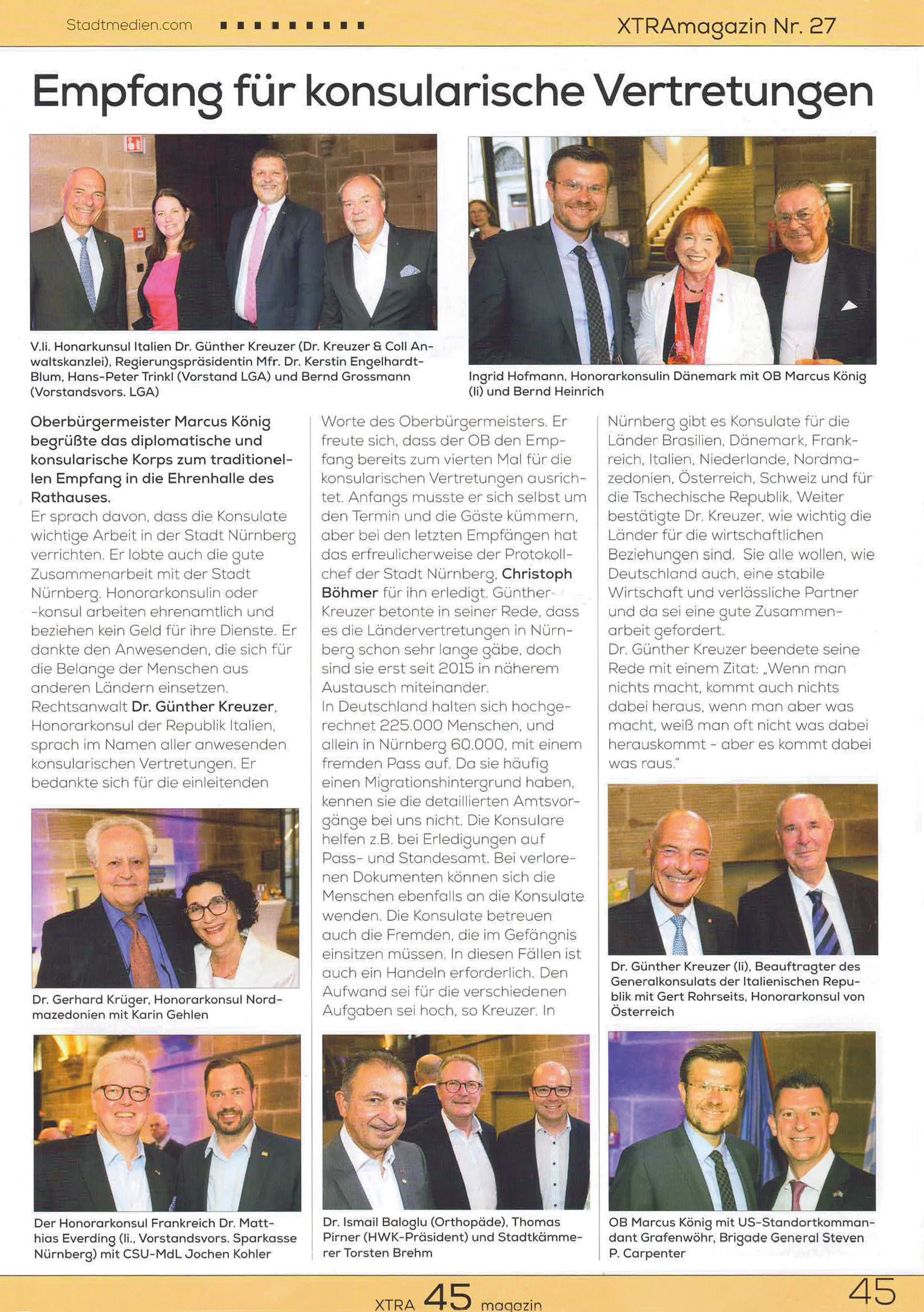
Erschienen im XTRA Magazin Ausgabe 27
Feierlich ging es am Martin-Behaim-Gymnasium zu. Es fanden sich viele hochrangige Gäste anlässlich der Verleihung der italienischen Zertifikate der Sezione italiana an die diesjährigen Abiturient:innen ein: Der Generalkonsul der Republik Italien in München Sergio Maffettone und der Beauftragte des Generalkonsulats in Nürnberg Dr. Günther Kreuzer, die Leiterin der Schulabteilung des Generalkonsulats Maria-Andreina LeFoche, die Ministerialrätin für Moderne Fremdsprachen am Kultusministerium Astrid Barbeau, die Referentin für Schule&Sport im Nürnberger Stadtrat Cornelia Trinkl, die Leiterin der Abteilung Italienisch am Sprachenzentrum der FAU Erlangen-Nürnberg Paola Cesaroni Meinzolt, sowie die Bezirksleiterin des Ausschusses zur Betreuung italienischer Schüler Lucia Tochini. Ihre Anwesenheit räumte diesem erstmalig stattfindenden Ereignis einen hohen Stellenwert ein. Im Jahr 2018 erfuhr der sprachliche Zweig des Martin-Behaim-Gymnasiums eine Aufwertung durch die Einführung die Sezione italiana, in der die Schüler:innen neben der deutschen Hochschulreife auch die italienische erlangen und nun als erster Jahrgang die Schule mit einem Doppelabschluss verlassen, der ihnen viele Berufswege eröffnen wird.

When companies or company shares are inherited, significant legal and practical problems arise, especially in the case where a community of co-heirs assumes the position of the testator (company owner), even if the question of compensation for heirs who are not appointed to the company does not arise .
All inheritance cases are affected in which
there is more than one heir (whether due to legal regulations or due to a will), and the inheritance includes a company or shares in a company.
Until the estate is divided
or at least until the partial dissolution of the company occurs, the administration, management and liability are generally the responsibility of the co-heirs as the new owners, which may be the case for years. It is irrelevant whether one or more of the co-heirs were involved in the management of the company before the inheritance. A co-heir’s previously granted power of attorney expires upon the death of the testator, which must be reported to the commercial register. A co-heir, especially if he or she managed the company alone before the inheritance, cannot generally deny the co-heirs' rights to inspect the business documents. As part of the basic joint administration, the co-heirs can appoint one of the co-heirs or a third party to manage the company, but this administrator is accountable to the community of heirs and is internally liable for any damage caused by him. Only in emergency transactions, which are therefore absolutely necessary to maintain the company, are individual co-heirs entitled to carry out transactions without prior coordination with the other co-heirs, for which they are then also liable and for which they are accountable. If joint administration is not possible, each co-heir can apply to the court to appoint a (third-party) administrator, who can then also be a completely uninvolved third party.
The Kreuzer Tip
Companies in the estate lead to a large number of legal and practical consequences for a community of co-heirs, especially with regard to liability and the further administration and management of the company. In order to protect the individual co-heirs, including with regard to compensation obligations, legal advice is urgently and promptly recommended.
Contact us!
Life insurance plays a large role in transferring assets after the policyholder's death. Given the high levels of assets that will be inherited in Germany in the next few years, this role will become increasingly relevant.
All inheritance cases are affected in which
In addition to the heirs (by will or by law), third parties should be considered as beneficiaries through life insurance policies of the testator. This can then lead to a race between heirs and beneficiaries. In the event of the death of the policyholder, the question usually arises as to whether a beneficiary agreement can be concluded between the testator and the beneficiary, which cannot be revoked and reclaimed by the heir. To convey the intention to make such an irrevocable assignment, intervention of a messenger is required.
Fact is: Before the beneficiary receives the information
That he/she is beneficiary the heir can revoke the donation if this is provided in the contract of the life insurance.The will of the testator can be subsequently "cancelled" if the heirs act quickly. An offer made after such a revocation is then no longer effective and cannot be accepted as such, which can lead to repayment obligations. Additional problems may arise from the fact that the insurance allows excessively long processing times.
The Kreuzer tip
Unless a life insurance beneficiary is irrevocably appointed, heirs may need to act quickly in the event of death to prevent unwanted life insurance payout claims from arising. Both in the event of death and before taking out life insurance, legal advice is urgently and promptly recommended due to the impact on heirs and estate as well as to secure any beneficiary benefits to be made.
Get in touch with us!
Im Rahmen der Blauen Nacht fand am 06.05.2023 in der Lichthalle des Heimatministeriums am Lorenzer Platz wieder die "Lange Nacht der Konsulate" statt. Hier präsentierten sich die in der Metropolregion Nürnberg ansässigen konsularischen Vertretungen von Dänemark, Italien, Nordmazedonien, Österreich, Schweiz, Türkei und Ungarn mit Informationsständen. Auch die Europäische Metropolregion Nürnberg, der Albrecht Dürer Airport Nürnberg und die NürnbergMesse waren vertreten. In Kooperation mit der Ausstellung „Horizonte – Geschichte und Zukunft der Migration“ des Germanischen Nationalmuseums fand eine gemeinsame Aktion unter der Überschrift „Heimat“ statt, dem Motto der diesjährigen Langen Nacht der Konsulate.
Nach der Eröffnung durch Rechtsanwalt Dr. Günther Kreuzer (Beauftragter des Generalkonsulats der Italienischen Republik) im Namen der anwesenden Konsulate, der die Bedeutung der Langen Nacht der Konsulate als internationales Schaufenster der Europäischen Metropolregion herausstellte, begrüßte Herr Dr. Alexander Voitl für das Heimatministerium die Teilnehmer und anwesenden Gäste zur Langen Nacht der Konsulate, die bereits zum 6. Mal im Heimatministerium stattfand, und überbrachte die Grüße von Finanzminister Albert Füracker und des bayerischen Ministerpräsidenten Dr. Markus Söder. Prof. Dr. Daniel Hess, Honorarkonsul der Schweiz, begeisterte am Ende seiner Erläuterung des Mottos „Heimat“ die Anwesenden mit einer musikalischen Kostprobe auf seinem Alphorn, einem typischen schweizer Instrument.
Beim anschließenden gemeinsamen Rundgang wurde an den Länderständen viel informiert. Überhaupt konnte man den ganzen Abend interessante Gespräche führen. Vorbeigeschaut haben auch Oberbürgermeister Marcus König, Bürgermeisterin Prof. Dr. Julia Lehner, Schulreferentin Cornelia Trinkl und tauschten sich auch mit den anwesenden Generalkonsuln Serdar Deniz (Türkiye) und Sergio Maffettone (Italien) aus.
Die diesjährige Lange Nacht der Konsulate war ein voller Erfolg, so Kreuzer. Die Besucherzahl wurde laut Heimatministerium im Vergleich zum Vorjahr deutlich übertroffen. Insgesamt haben 1038 Personen an diesem Abend die Veranstaltung besucht.

Fotoquelle:
Christian Poss
Stadtmedien Nürnberg
Büro Nürnberg
0911 2022 0
nuernberg@kreuzer.de
Büro Dresden
0351 31550 0
dresden@kreuzer.de
In its judgement of 20 December 2022 (case no. 9 AZR 266/20), the Federal Labour Court ruled that an employee's holiday entitlement is generally subject to the statute of limitations, but that the limitation period only begins to run once the employer has fulfilled his duty to inform and notify employees in this regard. In order to fulfil these obligations, the employer must inform his employees once a year about any outstanding holiday and summon them to take it, pointing out that it would otherwise expire.
The holiday entitlement
is aimed at release from the obligation to work for recreational purposes with continued payment of wages.
The general limitation period
of three years from § 195 BGB is also applicable to the holiday entitlement.
The period however only begins
at the end of the year in which the employer has fulfilled his duty to inform and notify the employee of the outstanding holiday and its expiry and the employee has nevertheless failed to take the holiday of his own accord.
The consequence of this is
that the employee's holiday entitlement cannot expire as long as the employer has not fulfilled his information and notification obligations. Under certain circumstances, a large number of untaken holiday days can therefore accumulate during the current employment relationship.
The entitlement to holiday pay in lieu
is due upon termination of the employment relationship and serves as financial compensation for outstanding holiday days. It is a purely monetary claim. This claim is subject to its own three-year limitation period and begins at the end of the year in which the employment relationship ends. In the case of this claim, however, the employer's co-operation has no influence on the start of the limitation period.
A transitional period applies
for the start of the limitation period for holiday pay compensation claims, as the rules for the forfeiture of holiday have only been established since the judgement of the European Court of Justice of 6 November 2018 (case C-684/16).
Kreuzer tip
Employers are strongly recommended to inform their employees once a year of any outstanding holiday, to ask them to take it and to point out that the holiday days will otherwise expire. This will prevent the accumulation of holiday days over many years, which may still be granted during the current employment relationship or may be paid out in cash upon termination.
Please contact us if you need more information on this matter.
The new Whistleblower Protection Act (HinSchG) will implement EU law and uniformly regulate and comprehensively change the protection of whistleblowers.
All companies are affected, no matter the size.The implementation
and operation of an internal reporting system is required in companies with 49 or more employees, although a whistleblower can also contact an external reporting office. Internal reports do not have priority. In addition to certain criminal behavior and conduct subject to fines, violations of certain national and EU regulations mentioned in Section 2 Paragraph 1 No. 3 HinSchG are now also covered by the very broad scope of protection. This includes not only violations by a company, but also misconduct by employees to the detriment of other employees or the company. Whether the reporting channel is anonymous or not depends on numerous factors.
The requirements for setting up and organizing these reporting channels are regulated by law in detail in Section 17 HinSchG, as is data protection in Section 11 HinSchG. It is also possible to pass the information to be reported on to a responsible authority. The reporting points can be operated and staffed by third parties or company’s own employees. The protection of the whistleblower requires that the information reported and already known to the whistleblower is correct or that the whistleblower had sufficient reason to believe that it was correct at the time of reporting. The law does not offer general protection against dismissals, but it does standardize claims for damages.
What has changed is that fines and compensation
will be attached when breach of confidentiality occurs. This applies in particular to the reporting office. In contrast to public bodies, the identity of the whistleblower may only be revealed to the employer with express consent, likely too in court proceedings. Jurisprudence will probably have to clarify how the confidentiality requirement and the data protection right to information can be reconciled. To protect whistleblowers from reprisals, a reversal of the burden of proof is introduced.
The Kreuzer Tip
Small and medium-sized companies in particular must set up internal, not necessarily anonymous, reporting channels very quickly, with Works Council and Data Protection Officer involvement. Legal advice is urgently and promptly recommended for the arrangement.
Get in touch with us!
With the “Law for the temporary reduction of the sales tax rate from gas deliveries via the natural gas network”, announced on October 25, 2022, the basis for an inflation compensation premium came into force retroactively to October 1, 2022. The premium is regulated as a tax allowance in Section 3 No. 11c EstG. It is intended to mitigate the rise in consumer prices.
The compensation bonus
allows employers to give their employees an amount of 3,000 euros tax- and duty-free for a limited period from October 26, 2022 to December 31, 2024. This is a voluntary employer benefit, to which employees generally have no enforceable claim.
The payment of the bonus
is not regulated in more detail by law and can be made during the benefit period in the form of a one-off payment, but also in partial payments or staggered payments, whereby the full amount does not have to be used. A cash reward does not necessarily have to be paid; benefits in kind can also be granted. The Works Council has a right of co-determination regarding the “how” of awarding bonuses. When granting the bonus, the employer must make it clear that the corresponding amount is related to increased consumer prices. For example, a note on the transfer slip as part of the payroll is sufficient. It could also be regulated through a personal letter to the employees or through a company agreement that the benefit is the compensation bonus.
Other contractually provided employer benefits
such as Christmas bonuses or bonus payments may not be converted into the inflation compensation bonus. The payment of the premium therefore has no influence on benefits already granted or to be granted by the employer based on an employment or collective agreement.
The Kreuzer Tipp
Many companies are currently considering how they can support their employees financially. The tax- and duty-free inflation compensation bonus has recently been considered for this purpose. A cover letter to the beneficiaries, a company agreement or a note on the pay slip can be used to ensure that the compensation bonus is a voluntary employer benefit. When formulating it, it is advisable to use the wording of Section 3 No. 11c EstG, which regulates the premium, as a guide. We would be happy to advise you on this and other options for supporting your employees financially.
In its decision of September 13, 2022 - 1 ABR 22/21, the Federal Labor Court decided that employers are obliged to record employees' working hours due to the current legal situation. This results from the Union-compliant interpretation of Section 3 Paragraph 2 No. 1 ArbSchG, according to which the employer must ensure a suitable organization, taking into account the type of activities and the number of employees, and must provide the necessary resources for this.
Time recording systems
serve to check compliance with the maximum weekly working hours and thus counteract risks for employees such as unpaid overtime and violation of rest breaks.
The time recording requirement
already existed before the decision of the Federal Labor Court and affects all employers. It requires the actual recording of the location, start, duration and end of working hours, so that simply providing a system by the employer is not enough.
The design of the time recording system
does not necessarily have to be electronic, so handwritten records are sufficient. Time recording does not necessarily have to be carried out by the employer; delegation to the individual employee is permitted. However, the employer must specify how time recording is designed and must also check that working hours are documented.
In case of violations,
according to the current legal situation, there is no immediate threat of a fine. However, it cannot be ruled out that the legislature will soon impose sanctions in the area of time recording. Even if there is no immediate threat of sanctions, employees can still assert a claim against their employer for the introduction of a time recording system, including through legal action.
The Kreuzer Tipp
If it does not already exist, it is advisable to introduce a time recording system according to the standards specified by the Federal Labor Court or to adapt existing time recording systems to these standards. For example, an Excel table or even a handwritten time recording kept by the respective employee is sufficient. We would be happy to advise you on implementing a time recording system – contact us!
In its judgment of November 20, 2019 - 5 AZR 578/18, the Federal Labor Court decided that when a working time account is set up by mutual agreement, it is implicitly agreed that the account must be financially balanced at the end of the employment relationship at the latest, unless otherwise agreed.
The establishment of working time accounts
serves to determine the time scope of the employee's work for which he can claim his remuneration.
The reduction of a working time account
takes place according to the underlying agreement (contract, works agreement, collective agreement), often through compensatory time off.
After termination of the employment relationship
compensatory time off is no longer possible. In the absence of an express agreement, according to case law, the mutual establishment of a working time account constitutes an implied agreement to settle the account financially upon termination at the latest.
No exclusion periods apply
if the credit hours have been established without dispute because a balance in the working time account has been unreservedly shown in favor of the employee and has not been reduced until termination.
The Kreuzer Tipp
In addition to an employment contract agreement, it can also make sense to declare the time off (also) to fulfill the entitlement to compensatory time off when paid time off is declared following a dismissal and taken into account against certain entitlements. We would be happy to advise you on how to proceed.
With an important decision, the Federal Labor Court now gives the employer, under certain circumstances, the opportunity to undermine the high evidentiary value of a certificate of incapacity for work (AU certificate).
Obligation to provide evidence
by the employee for his illness, in principle by presenting a medical certificate of AU, which is usually sufficient as proof - even in legal proceedings.
The consequence
is that the employer must present and prove actual circumstances that raise doubts about the employee's illness.
If there is a coincidence or coincidence between the AU period and the termination and the subsequent end of the employment relationship
In case of doubt, the employee must provide concrete evidence of circumstances that indicate an existing illness and actual AU.
Example
On June 20, 2022, A terminates the employment relationship which ends on July 31, 2022. At the same time as his declaration of termination on June 20, 2022, he submits an initial AU certificate that initially gives him sick leave until July 15, 2022, then a follow-up certificate that gives him sick leave until July 31, 2022, i.e. the end of his employment relationship. If the employer now presents and proves circumstances that give rise to serious doubts about the inability to work, he may be able to undermine the evidentiary value of the AU certificate. Then A must explain in detail and prove that he was/is really unfit for work. For this purpose, for example, the doctor who took the sick note can also be interviewed after being released from the obligation of confidentiality.
The Kreuzer Tipp
Sick notes around notice periods are subject to their own requirements and evidence. Legal advice is strongly recommended to assess doubts in individual cases. Contact us!
In a ruling dated 25.10.2018 (14 Ca 2289/18), the Cologne Labor Court ruled that, due to a change in the law, an exclusion period in an employment contract, that is designed as a general term of business and makes the assertion of claims against the other party dependent on the written form, is invalid. This applies to all employment contracts concluded since 01.10.2016.The norm in employment contracts.
The rule in employment contracts
is the agreement of so-called two-stage exclusion periods. In the first stage, claims arising from the employment relationship must be asserted against the other party within a period of time. If the party does not respond to this, the claims must be asserted in court at the second stage within a further period.
If the assertion must be made to the contractual partner in writing
the clause is invalid pursuant to Section 309 No. 13 b) BGB. Accordingly, no form stricter than text form may be agreed. In contrast to the written form, assertion in text form also includes assertion by email, for example.
Consequence of ineffectiveness
at the first stage is the ineffectiveness of the exclusion period as a whole. The statutory limitation period of three years applies.
The Kreuzer tip
It remains to be seen whether this case law will be confirmed by other courts. However, in order to guarantee the effectiveness of the limitation period, it is advisable to amend the contractual terms. Talk to us!
The planned amendment to the German Act on Evidence (NachwG), which implements an EU directive, will in future oblige employers to record the key aspects of the employment relationship even more extensively in writing.
The expansion of the obligations to provide employment contract clarity
in the catalog of Section 2 NachwG, includes but is not limited to, the duration of the probationary period, overtime and modalities of shift work, and also comprehensive information related to the termination procedure.
The deadlines
for providing a written and signed employment contract have changed. For new employment relationships, the deadline has been shortened from one month to the first workday, in alignment with certain contractual conditions. In cases where there is an existing employment contract, and the employee requests a revised contract in alignment with the new regulations, this deadline has been extended to seven days after the request is made.
A new administrative fine
in the event of non-fulfilment, incomplete fulfilment, incorrect fulfilment, incorrect fulfilment in the prescribed manner or untimely fulfilment of the obligation to comply with the new regulations, has been introduced.
Companies often obtain enforcement orders, but enforcement comes to nothing because the debtor's earnings only reach the garnishment exemption limit. If there is a suspicion of income concealment, the following steps can be taken:
Application for an attachment and transfer order
which also includes a fictitious claim to remuneration that may arise in the event of concealed income from employment.
Request for information
to the judgment debtor and the employer after or upon service of the attachment and transfer order with regard to the nature and temporal scope of the work.
Filing an action for recovery
against the employer for payment of the attachable part of the fictitious net remuneration after information has been provided.
The Kreuzer tip
If you suspect that the debtor in execution is concealing his true income, you do not have to accept this! We will be happy to advise you on how to proceed.
Partial retirement is becoming increasingly relevant. However, it is associated with obligations, particularly with regard to the credit balance from work performed in advance in the first block, as otherwise there is a risk of claims for damages, including against the managing director.
The credit balance
must be specially protected. The purpose is to grant the employee a right to segregation in the event of insolvency, as this is the only way to make his or her credit balance "insolvency-proof" and meet the legal requirements.
A trust agreement
with a third party who manages the gross credit balance (including social security contributions) transferred to him on behalf of third parties is effective and economically sensible and can be structured as a pledge model or as a so-called double-sided trust agreement. The latter is generally more practical and flexible.
The Kreuzer tip
Securing this credit balance under insolvency law is mandatory, Section 8a of the German Partial Retirement Act (ATzG). Legal advice is strongly recommended for the structuring. Talk to us!
The new Supply Chain Due Diligence Act will bring far-reaching and extensive new obligations for companies to comply with human rights and environmental rights in their supply chains from 2023.
Almost every company
must monitor and document compliance with such standards throughout the entire supply chain (with gradations), regardless of its legal form. Risk analyses must be carried out.
Preventive measures
and risk management, including complaints procedures and a human rights officer, must also be established. In the event that companies fail to comply, fines of up to 8 million euros or 2% of the average annual turnover can be imposed and companies can be excluded from public contracts.
The Kreuzer tip
The design of the measures to be taken still needs to be specified, but should be addressed now in preparation. Legal advice is urgently and promptly recommended for the structuring. Talk to us!
Working from home and mobile working have become increasingly important beyond mandatory offers, even more so since the coronavirus pandemic. However, they are legally different formats.
When working from home
the employee has a workplace in the same sense as a company workplace - including all occupational health and safety requirements.
Mobile working, on the other hand
means that the employee can work from any location. In this case, occupational health and safety requirements only need to be observed to a limited extent.
For both variants
agreements must be made on the basic permission by the employer and in particular on the work equipment used, data protection, confidentiality and, if applicable, the use of private end devices.
The Kreuzer tip
Mobile working offers more flexibility and does not require a "formally" set up workplace. A written agreement stipulating a comprehensive arrangement is strongly recommended. Talk to us!
A higher court has now ruled on how to deal with commercial rents due to corona-related closures.
The BGH has clarified
that loss of turnover due to business closures does not constitute a rental defect; loss of turnover is generally the tenant's risk of use. However, there may be a claim for contract adjustment if the closure is ordered by the authorities.
Such pandemic-related closures
are outside the usage risk, at least in the case of rental agreements concluded before the pandemic, as they were not conceivable before the pandemic.
However, in contrast to previous case law, a rigid one-half distribution
of the risk is inappropriate and the distribution must be assessed according to the circumstances of each individual case.
The Kreuzer tip
In ongoing disputes, the underlying contracts and the distribution of costs should be urgently reviewed. There is also a need to adjust new contracts with regard to the foreseeability of pandemic-related closures. Talk to us!
The corona pandemic with the resulting legal regulations is causing considerable uncertainty in the family. Important aspects for you below:
Support for parents
If the child has not yet reached the age of 12, if the care facility or school is closed and there is no reasonable alternative care option, compensation of 67% of the net income, up to a maximum of EUR 2,016 per month, will be paid upon application. It is important to know that the application for compensation can still be submitted within twelve months.
If you have statutory health insurance, child illness benefit is paid for longer and special leave is granted if the child needs personal care and one parent cannot work. This also applies if parents have been asked not to bring their children to the facility. Parents who could theoretically work from home should also receive child sickness benefit. If child sickness benefit is claimed, both parents are not entitled to compensation (share of net income) during this time.
20 days of child illness benefit are provided per child per year. Single parents receive 40 days. Anyone who has several children can use the entitlement for up to 90 days. However, the child illness benefit must be stated in the tax return: The health insurance companies transmit the child illness benefit payments to the tax office.
Compensation benefits during quarantine
In the event of quarantine, employees will be paid compensation by their employer in the amount of the loss of earnings for the first 6 weeks. From the beginning of the 7th week, compensation equal to the sick pay is paid directly by the responsible authority. The employer has a claim to reimbursement from the state.
Bonus for employees in geriatric care and hospitals
The employers pay out another 1000 - 1500 EUR. The bonus is tax-free. Under family law, the increase in income resulting from the bonus payment is not counted towards spousal maintenance; in the case of maintenance for minors only if the minimum maintenance is not guaranteed.
Unemployment due to Corona
Anyone who is affected by unemployment as a result of Corona and is obliged to pay maintenance will be forced to use their unemployment benefit as a basis for calculating the amount of maintenance. The question arises as to whether a real employment opportunity still exists and whether a higher income can be achieved again in the future.
Short-time working allowance
There are different regulations for the crediting of additional earnings against short-time work benefits, depending on the proportion of reduced working hours and the employment from which the additional earnings result (system-relevant sectors and professions!). The short-time working allowance is tax-free, but is subject to the so-called progression reservation, like an unemployment benefit. This can result in increased income tax being incurred overall, although this can only be correctly determined with the annual income. If an increased income tax is incurred, the available net income is reduced. This can also affect the amount of maintenance obligations.
Obligation to file income tax returns
The employee is obliged to submit a tax return if tax-free payments are made, such as short-time work allowance, Corona aid or compensation under the Infection Protection Act. This may increase the tax burden, but this can only be determined later and can lead to problems in terms of maintenance law.
Corona vaccination for underage children
Disputes can arise between parents as to whether their children should be vaccinated. In the meantime, it was decided that the decision about vaccination should be transferred to the parent who supports the vaccination of the child in accordance with the recommendations of the STIKo, provided that the child does not have any particular vaccination risks. The child's will only conflicts with this if the child can form its own opinion on this subject in view of its age and development. In the case decided, the family court did not consider the will of the 12 and 14 year old children to be decisive for this issue of custody.
The Kreuzer Tip
Are you an employee? Check the options for support services. Have your maintenance obligations and possible options for modification checked! We offer help with checking maintenance obligations, assessing changes in income and additional income opportunities: There is a lot to consider due to the legal regulations in connection with Corona. We would be happy to check your maintenance obligations for you and provide you with comprehensive information about the applicable Corona regulations!
© Copyright 2022